Broadway World
by Richard T. Green /
July 17, 2026
You've probably heard of "the doorway effect," where you walk into a room and forget why you went in there in the first place. In a Midnight Company production, Will Eno's 2017 play Wakey Wakey subtly turns this "portal amnesia" into a transcendental state, a much to be desired condition, ethereally directed by Ellie Schwetye at the Chapel on Alexander.
I've heard it described as a survival instinct, the sudden threshold blankness that wipes away any foolish preconceptions about our arrival in a new (and possibly dangerous) set of circumstances. But survival becomes entirely secondary to just learning how to seize a magical moment of not knowing.
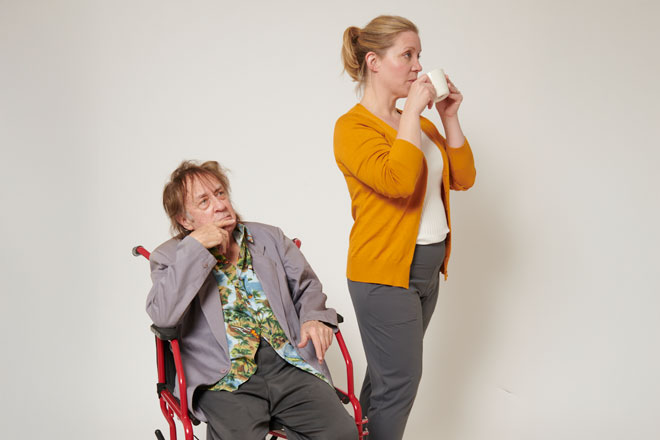
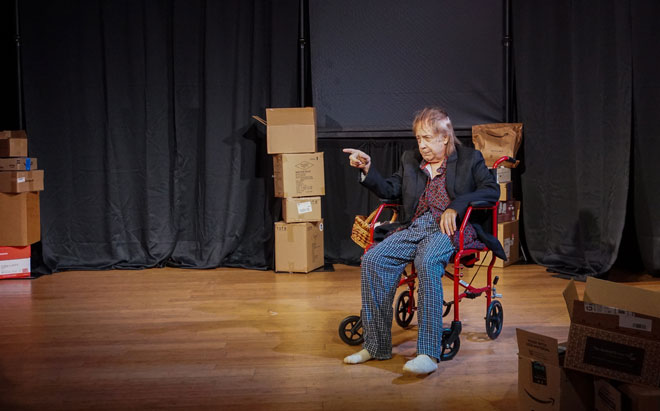
For the audience, the "possible danger" is death itself, as an old man (Joe Hanrahan, the founder of this company) waits to be wheeled out of his house one last time, surrounded by boxes of belongings, perhaps the remains from a yard sale, stacked up all around. A caretaker, Lisa (the wonderful Rachel Hanks), appears later in the very subdued action. And it's possible that Wakey Wakey will be as close as modern theatre gets to a Sunday morning church sermon, where Mr. Hanrahan, in a gentle, husk-like performance, guides us from one transitional moment to the next (though we're asked not to say how long this one-act play actually is). But, like the production's swirling tunnel of infinity, something eternal rings in your ears long after the sermon's over.
It's like Beckett, if Beckett were Buddhist I suppose, which almost sounds unconscionable. Why would you rob the author of Waiting for Godot of his last great possession, his own gargantuan fears? But Ms. Hanks' sunny disposition and saffron-colored sweater help change the chemistry of this end-of-life comedy, though not as much as Mr. Hanrahan's own gentle guidance toward a final threshold. And where Beckett's characters seem to be running away from something terrible, Mr. Eno's exercise in pure awareness is much more distinctly American, befuddled and hopeful and comfortably numb to the darker side of entropy. Here, Mr. Hanrahan's like a rumpled Lieutenant Columbo, squinting to see things anew one last time, as his existence tends toward a kind of mental yoga. The gradual twisting of his mind into a pretzel of infinity becomes the desired state, more than any completed lotus position itself.
The show doesn't ask us to put on a brave face, nor to ignore the mind's invisible swirling alligators of infirmity, as we're lowered into some nightmarish pit of diminished capacity. But Ms. Hanks' Lisa is endlessly reassuring, and regularly tries to draw him out, in any positive way she can. And unlike the incomprehensible tape recorder in Beckett's Krapp's Last Tape, each moment spent fumbling with a TV remote, or with a little pile of index cards, becomes like the everyday meaning of life itself: an eternal moment of hunting and gathering, where waiting itself must wait in the wings.
It's immensely comforting to be reminded of the positive turning points in one's life, as happens here. And the play's meditations on the door-like nature of life's biggest questions makes a long and healthy survival seem almost beside the point–like the dangling, inconsequential tail on a kite. In this one-man/two-person meditation, consciousness finally flies up on a billowing wind. As day-to-day existence, like some very marginal counter-balance, sways below.
Snoop’s Theatre Thoughts
MIDNIGHT'S ENGAGING "WAKEY WAKEY" FEATURES STRONG, THOUGHTFUL PERFORMANCES
by Michelle Kenyon ("Snoop") /
July 17, 2026
The Midnight Company’s latest production is a short but thoughtfully staged intimate look at one characters ponderings on life and mortality. Starring Midnight’s artistic director Joe Hanrahan and directed by Ellie Schwetye, this is a show that doesn’t really have a plot, but there’s a lot to think about. It’s also clever in its use of audience interaction.
Hanrahan’s character is billed as “Guy”, and it’s not entirely clear if that’s his name or a generic description. The truth is, he doesn’t need a name, since many of his reflections are universal and can apply to almost anyone. He starts the show sleeping in a wheelchair, and when he wakes up he isn’t entirely sure it’s time to start his presentation. He then proceeds to go through a series of reflections and questions about life and what it means, including remembering important events and people, and challenging the audience to do the same. Late in the show, as Guy has become a little more agitated, Rachel Hanks appears as Lisa, a calming presence who states that she’s there to help. As the play winds down, it soon becomes more clear what’s going on, but I won’t spoil that part.
Hanrahan is the show, essentially. His characterization is likable and engaging, if a little mixed up at times, and his interactions with the audience seem natural and engaging. He easily carries the majority of the show’s approximately one hour running time, aided by some fun projections designed by Zac Grimm. Hanks is also excellent, adding to the drama and working well with Hanrahan’s character. There’s also excellent work from director and sound designer Schwetye, lighting designer Tony Anselmo, and costume designer Liz Henning to help set and maintain the contemplative mood of the show.
Wakey Wakey is like a conversation and a thought exercise rolled into one. Its focus on one relatable central character–with eventual help from another, calming presence–makes it fascinating. It works especially well in the small space at the Chapel. It’s not a long play, but there’s a lot to think about here, and while there is some humor, for the most part its a solemn reflection. If you’re up for examining life and mortality, and experiencing some excellent performances, it’s worth checking out.
Two On The Aisle
by Gerry Kowarsky / July, 2026
When the lights come up in Will Eno’s Wakey Wakey, a man in pajama pants says, “Is it now? I thought I had more time.” This is a reasonable thing for an awakening man to say, but it is also a poignant reference to the speaker’s mortality. “We’re here to say good-bye,” he says later.
Meanings both on and beneath the surface, unpredictable tangents, half-finished thoughts, and gallows humor make “Wakey, Wakey” a challenging and fascinating play to watch in the excellent production by The Midnight Company.
The one speaking character for most of the play is called Guy in the script, but is that his name or a generic description of an everyman? From a wheelchair, he speaks directly to an audience, but is this audience in the theater or his mind? “This was originally going to be something else,” Guy says, adding “I don’t know what it is, now.” He has prepared index cards and a slide show with sound, but he is easily distracted and skips from one subject to another.
Guy is played by Joe Hanrahan, a past master at performing Eno monologues. He presented Thom Pain (based on nothing) in 2006 and 2016, and Title and Deed in 2017. Under Ellie Schwetye’s sensitive direction, Hanrahan commands attention in Wakey Wakey with his ability to shift seamlessly between humor and pathos, his deep understanding of how an Eno narrator thinks, and the virtuosic timing needed to depict spontaneity.
The situation in the play becomes clearer with the arrival of the second character, Lisa, who is looking after Guy. In Rachel Hank’s beautifully judged portrayal, Lisa is a concerned, totally professional caregiver who moves the play toward a deeply affecting conclusion.
The Midnight production showcases the fine work in Liz Henning’s costumes, Tony Anselmo’s lighting, Zac Grimm’s projections, and Ellie Schwetye’s sound.
Ladue News
"WAKEY WAKEY" IS ON TIME IN ALERT MIDNIGHT COMPANY PRESENTATION
by Mark Bretz /
July 17, 2026
Story: Guy is dozing in his wheelchair, situated between a number of boxes strewn about his room. When he opens his eyes, he acknowledges the audience and welcomes us to share some time with him as he attempts to regale us with his thoughts, observations, and memories about his life, humanity in general, and those omnipresent topics, namely life and death.
He looks at us and ponders, "Is it now? I thought I had more time." He's not especially anxious or hyper about this, just resigned to reality. Guy tells us that hundreds of thousands of people died today. He further says that hundreds of thousands of people die every day. Death, after all, is a big part of life, and Guy seems pretty much OK with that. "Time is your friend," he tells us, "and time is your enemy." True enough.
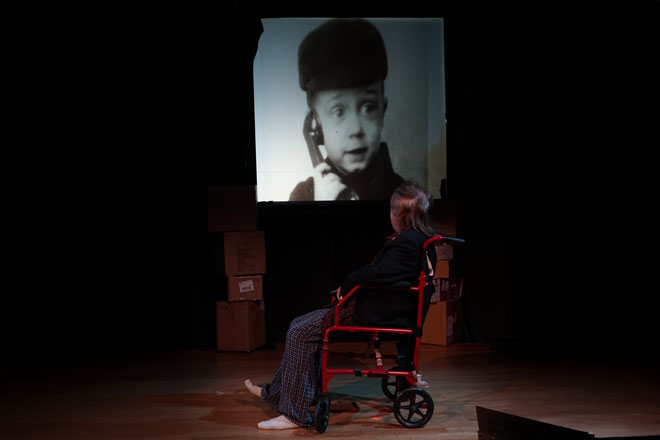
He enjoys, it appears, dispensing his pearls of wisdom, ruminations acquired through decades of living on planet Earth. He bickers occasionally with an unknown person who assists him with elements of his explanations, such as a slide show giving us a glimpse of Guy as little more than a toddler, and then as a child. He may have something to say about that, or not, depending on his mood.
"Certain feelings cannot be replaced by thoughts," he observes in one of his more reflective moments. He appreciates certain elements in his presentation but rails against sounds he finds inappropriate, annoying, or both. His advanced years have somewhat earned him the right to be curmudgeonly. And he enjoys bantering with his witty bon mots and clever word games. Guy still has game beyond the words.
He acknowledges the eventual arrival of Lisa, a home-care aide who is understanding without being condescending, gracious without being gratuitous, kind beyond superficiality. Lisa is a young woman whose occupation, or calling, fits her like a well-worn but stylish glove. We think that Guy knows this, too.
Lisa has forgotten to bring along some of her usual accoutrements but makes do with a bottle of bubbles, which she playfully blows throughout the room. The bubbles are light and ephemeral, buoyantly strong at one moment, fragile and dissolved the next.
She brings that harbinger of Guy's life and death to his sanctuary, where he has greeted us in his pajamas, and later remarked with wonder that he can walk! He already knew that, though. Guy enjoys hosting the games, entertaining us, while Lisa's congeniality is a welcome addition.
John Mellencamp sang, "Oh, yeah, life goes on, long after the thrill of living is gone." In Guy's case, the thrill may yet linger in his dry and witty sense of humor.
Highlights: The Midnight Company, with founder and artistic director Joe Hanrahan essaying the role of Guy and Rachel Hanks as the personable Lisa, presents the local premiere of this one-act, 2017 work by noted playwright Will Eno. Director Ellie Schwetye maintains a careful, studied cadence with her direction to elevate the mood of a subject that can be forlorn by its very topic.
Other Info: Eno's script, barely an hour long, had a limited Off-Broadway run in 2017, starring Michael Emerson ("Lost") as Guy, another name for Everyman. Hanrahan has previously starred in two shows written by Eno, Thom Pain (Based on Nothing) and Title and Deed.
In Wakey Wakey, Eno again engages in dialogue designed to challenge an audience as much as entertain them, commenting on the world at large. Hanrahan shows an affinity for Eno's scripts and other plays that focus on existential matters as much as present a semblance of a plot.
Midnight's production of Wakey Wakey is given solid technical support by lighting designer Tony Anselmo, sound designer Ellie Schwetye, costume designer Liz Henning, and projection designer Zac Grimm, who fills the background screen with home movies of Guy as a toddler and child, wide-open skies, and other points of interest in Guy's life that were special to the character.
Schwetye draws convincing and empathetic portrayals from Hanrahan and Hanks as the somewhat wistful Guy and the caring, kind-hearted Lisa, respectively, leading her players and the audience to the show's logical conclusion.
Much like life and death, Guy's story will leave some viewers seeing a glass half full, while others may be frustrated by what they perceive as a half-empty vessel. It's all in the telling, and accepting, of the story - its gravitas or brevity - Eno's take on an old and all-too-familiar tale.
Broadway World
by James Lindhorst / July, 2026
Wakey Wakey, the 2017 play penned by Will Eno, is currently enjoying its St. Louis premiere at The Chapel. The Midnight Company’s production, directed by Ellie Schwetye, stars Joe Hanrahan as Guy and Rachel Hanks as Lisa.
The Midnight Company has produced two of Eno’s other works, the Pulitzer Prize finalist Thom Pain (based on nothing) and Title and Deed. Eno made his Broadway debut in 2014 with his quirky The Realistic Joneses starting Toni Collette, Michael C. Hall, Tracy Letts, and Marisa Tomei.
Wakey Wakey opens with Guy (Joe Hanrahan) uttering a simple sentence to tell the audience that he is aware of his imminent mortality. For the next 45-minutes Guy ponders the life he has lived. He reminisces about his past and opines about gratitude, laughter, and life.
Eno’s play is not morose. Instead, it is an insightful and often humorous look at the final stage of grief, acceptance. It is often said that dying unexpectedly in your sleep is more merciful than an illness requiring a person to deal with the five stages of grief. Eno’s monologue considers the opposite. Is acceptance and the opportunity to reflect on a life well-lived the ultimate sense of closure?
Ellie Schwetye’s direction, set, and sound design create a tranquil sense of comfort. Guy’s life is neatly packed up in boxes stacked around the stage. Schwetye’s music choices set a tone of nostalgia and Tony Anselmo’s lighting design provides coziness and warmth.
Schwetye has elicited a thoughtful and pensive performance from Hanrahan. His pacing and timing show a man who is contemplative and reflective. Hanrahan is both introspective and funny in his direct monologue to the audience. He is composed and conversational sharing observations that are philosophical and uplifting. Hanrahan portrayal of the dying man is natural and convincing.
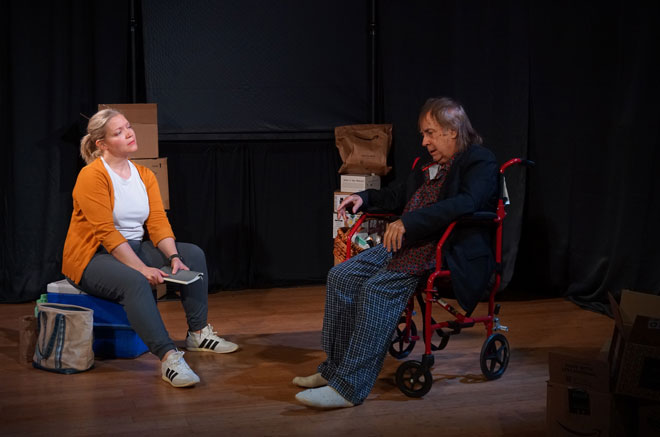
Rachel Hanks is Lisa, a hospice nurse who arrives with just a few minutes left in the play. She’s caring, supportive, and has obviously worked with this patient to help them prepare for end of life. As Guy weakens, Lisa prompts his memory while creating a light and almost joyful environment for Guy.
Eno’s end of life play is thoughtful and funny while avoiding morbidity. There is no fourth wall. The direct address monologue is a unique narrative structure that is rarely used by playwrights, but a style of storytelling that’s often staged by The Midnight Company (Thom Pain, The Absolute Brightness of Leonard Pelkey, Now Playing Third Base for The St. Louis Cardinals…Bond, James Bond.)
A play that is primarily a monologue is in Hanrahan’s wheelhouse as an actor. He and Schwetye have collaborated to stage a poignant reading of Eno’s off kilter script.
PopLifeStl.com
MIDNIGHT COMPANY’S "WAKEY WAKEY" CELEBRATES LIFE’S JOY AND WONDER
by Lynn Venhaus / July, 2026
“Is it now? I thought I had more time.”
A guy, clad in pajama pants and sitting in a wheelchair, utters those words. That’s the start of Wakey Wakey, a clever, insightful rumination on the humanity that connects us all.
Written by American playwright Will Eno, this thoughtful 2017 dramatic comedy is the latest uncommon offering from The Midnight Company and is a St. Louis premiere. In the title role of Guy is the company’s founder and artistic director, Joe Hanrahan. He’s charming, disarming and funny as an everyman facing mortality.
Eno’s rhythms ideally fit Hanrahan because it’s like everyday conversation in a natural stand-up routine way. He has performed Eno’s plays Thom Pain (based on nothing) twice (a finalist for the 2005 Pulitzer Prize), and Title and Deed before, so he is familiar with the anxious musings and reflections about the cosmic wonders that intrigue us every time we look up at the sky.
Eno’s written seven plays and known for a quirky writing style – fragmented dialogue and philosophical commentary. As Guy, Hanrahan, looking rumpled with disheveled hair, has come to terms with his final days. He speaks to the audience directly, reading from index cards like he’s addressing the local chamber of commerce. He starts pondering life, grief and survival, then takes sharp turns into precise off-beat subjects. Hanrahan, with self-deprecating wit, is in a jolly mood sharing space with the audience.
He has slides to show, too. And he’s trying to figure out the remote control for the ‘clicks.’ His befuddlement struck a chord with the audience. It may feel random, but it has a point – and the more esoteric, the more it seemed to connect.
The audio, impeccably designed by director Ellie Schwetye, features snippets of songs and sound bites to fit the visual elements. The projection design is by the skilled Zac Grimm, who won the first-ever St. Louis Theater Circle Award for visual effects design in 2025, for Liz Lewy’s remarkable “Longing.”
At times, Wakey Wakey might feel like you’re back in a dorm room, talking about life, existential philosophies and aging. What do we think is worth celebrating and worth treasuring, and will we feel that way when we’re older? Laced with laughs, the audience gets a kick out of Hanrahan engaging with the audience, breaking the fourth wall. Guy looks like he’s surrounded by boxes, living in a place that’s not his home, but is his final address. Written material indicates it is a hospice situation.
We all know that no one gets out alive, right, so instead of it being sad — Eno enlivens the conversation. Joe’s not alone, either. Rachel Hanks arrives midway through the one-act, as Lisa, saying she is to check on him. She’s a grounded presence, always.
The creative team ensured this was not just a simple ‘monologue,’ but rather a theatrical endeavor that said something, meant something, and we felt connected, starting with Schwetye’s crisp direction. This is her 11th collaboration with Hanrahan, and they’ve united on memorable productions, including Tinseltown, which won the St. Louis Theater Circle Award for Best New Play. Lighting designer Tony Anselmo superbly enhanced the visual aspect.
The key takeaway – which gets patrons talking – is that we don’t value the small things in life until, perhaps, it’s too late. So, celebrate them all: moments of laughter, wonder, joy and each other. The set-up at the Chapel lent itself to the cozy atmosphere, which felt very communal.
When Joe delivered the line: "We need to get better at saying hello", that spoke to me. But there are many things that spoke to the ‘right here, right now’ of living in 2026.
TheArtsSTL
"WAKEY WAKEY" PUTS THE "FUN" IN "FUNERAL"
by Rob Von Nordheim / August, 2026
Imagine yourself in a small room, surrounded by cardboard boxes. There’s a crowd gathered around a man in a wheelchair. He seems to be in charge; in fact, he seems to be the only person who knows why any of you are even here. Over the course of the next hour, you’ll hear this man’s thoughts on life and death and the nature of the world. You’ll also watch some funny animal videos and see some cute pictures of kids eating ice cream. What does it all mean? Even our MC doesn’t seem to know for sure, but we’ll all figure it out together, somehow.
That is the setup for Wakey Wakey, an 80-percent one-man show from The Midnight Company. Written by acclaimed contemporary playwright Will Eno, it has the feel of a comic monologue crossed with a eulogy, with a little bit of performance art thrown in. Like most of The Midnight Company’s mainstage shows, it takes place at The Chapel (6238 Alexander Dr.), a beautiful performing arts space located near Forest Park. Connected to a historic church and featuring pews and stained glass windows, it is an appropriate event space for a play which, as the title suggests, is written as an eccentric and surprisingly entertaining wake.
The program identifies our guide as “Guy,” but you will rarely hear his name spoken. In fact, you will learn almost nothing about this man’s past, but you get a definite feel for him as a person. That’s due to Joe Hanrahan and his impeccable comic chops. Hanrahan, who is also the company’s creative director, controls the narrative flow with casual cool. He spends the majority of the hour sitting in his wheelchair, though he occasionally gets up to stretch or fetch objects from around the room. Pulling cue cards from a basket and wielding a TV remote, he triggers a disco ball, word scrambles, and other bursts of light and sound. Is this some elaborate psychological experiment?
Eno’s script nixes any sort of exposition. Instead, we glean Guy’s philosophy of the world and his attitude toward life in real-time. Hanrahan plays him as a man determined to have the last laugh, an MC trying to keep the show going for as long as he can, bringing a weary, resigned feeling to the performance. His sardonic sense of humor masks his sadness and regret, the true source of which comes into sharp focus at the end of the play in a stark, earned tonal shift. In the final ten to fifteen minutes, Guy is joined on stage by a character named Lisa, played by Rachel Hanks. Her brief appearance helps ground the emotional conclusion of the play, bringing a quiet dignity to the proceedings.
Public speaking is a fear greater than death for many, but Guy has clearly reached a place beyond that fear. He may be trapped in a failing, aging body, but his spirit is too large to be contained and is finally free to wander. It makes for a fascinating communal experience and a necessary alternative to the big, loud, dazzling musicals that tend to dominate the St. Louis summer theater season.
|










 Now Playing